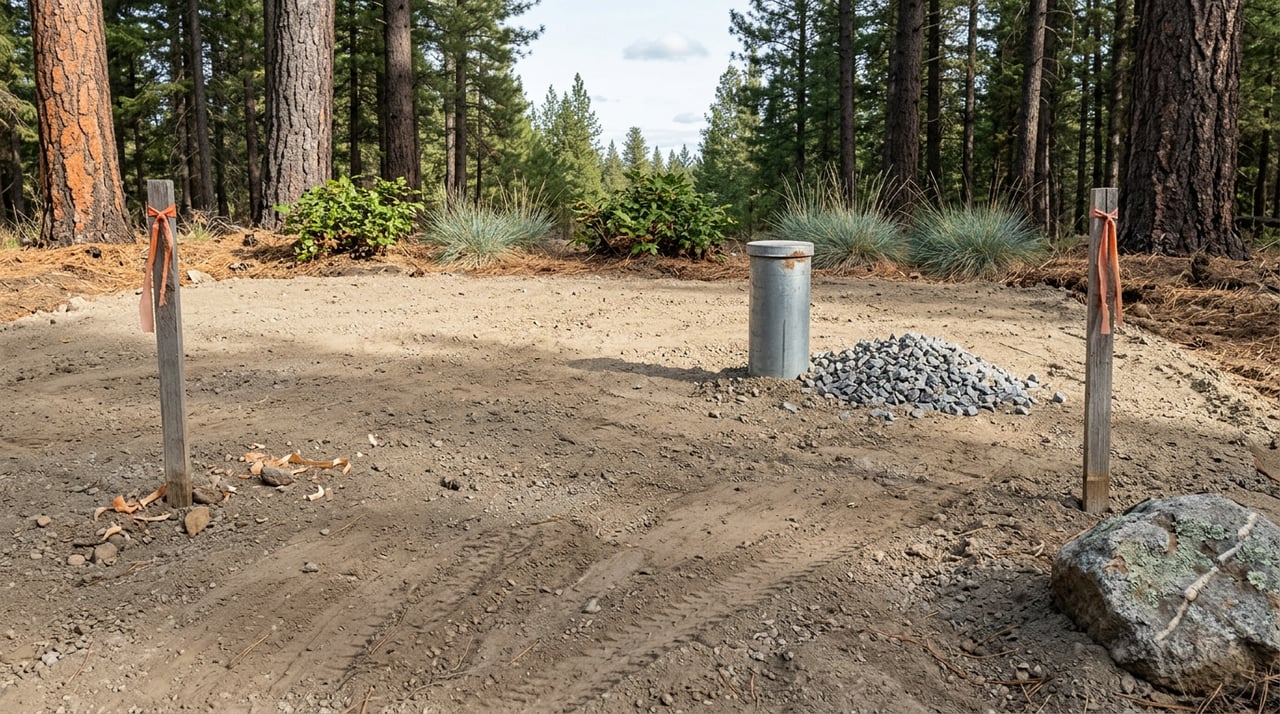
Scroll through land listings in Pine, Colorado right now and you'll notice something odd. Two five-acre lots can carry nearly the same price, sit a half mile apart off Highway 285, and read like completely different products. One says the well and septic are already in, engineered, ready to build. The other says plainly: buyer to drill a well and install a septic system. Same acreage. Same mountain views. Wildly different timelines and costs waiting on the other side of closing.
Buyers usually assume the gap between those two listings comes down to price per acre, or maybe how close the lot sits to Highway 285. It doesn't. The real variable is almost always buried where nobody thinks to look until it's too late: the age of the septic system and which side of an elevation line the parcel falls on. Those two facts, more than the view or the acreage, decide what a Pine lot actually costs to finish and how a lender will treat it.
The Inspection Nobody Mentions in the Listing
If you're buying a Pine property that already has a septic system on it, Jefferson County has a rule that catches a surprising number of buyers off guard at the worst possible moment. Under the county's OWTS Use Permit Program, any onsite wastewater treatment system installed more than five years before the sale date has to be inspected and issued a use permit before the property can legally change hands. That inspection isn't optional paperwork you can skip if the seller says the system "works fine." The county requires it, and the application needs to go in at least 10 working days before the scheduled closing.
Here's where it gets interesting for a mountain lot in Pine. If the system fails that inspection, or if it lacks a proper septic tank, the county requires it to be repaired or upgraded before the use permit can be issued. Jefferson County's repair permit fee currently runs $1,023, or $523 if the fix is limited to adding or replacing the tank itself. That's before you factor in the inspector's own fee, which the county doesn't set, and before you factor in any actual repair work if the leach field itself has failed.
The use permit, once issued, is only good until the closing date or six months, whichever comes first. So a seller who waits until under contract to schedule this inspection is often racing a clock they didn't know existed. If you're the buyer, this is worth asking about in your first conversation with a listing agent, not your last one. Ask when the septic was installed and whether a use permit inspection has already been scheduled. If the system was installed after 1965, county records may have the original design on file, which can save real time.
Where the Elevation Line Actually Sits
Colorado's septic rules draw a hard line at 8,000 feet. Systems installed above that elevation require an engineered design rather than a standard conventional layout. Pine straddles this line more than most people realize. One recent Pine listing sits at 8,520 feet, described by the listing itself as the highest point before the Continental Divide, and features a capped, monitored well already in place. Other Pine parcels off Highway 285, closer to the valley floor, sit comfortably below that threshold.
That elevation difference is not cosmetic. Jefferson County already requires a registered professional engineer to design any septic system in the county given how challenging its terrain and soil conditions are. Cross above 8,000 feet and you add the state's engineered-design mandate on top of that, along with a shorter construction season and, often, rockier ground that complicates excavation. The cost spread reflects it. A conventional septic system on flat, cooperative soil can run around $15,000. An engineered system on a steep, rocky, high-altitude lot regularly runs past $40,000, and that's before well drilling.
Two lots at the same price point in Pine can carry a $25,000 swing in what they cost to finish building on, and the number one predictor of which side of that swing you land on is the elevation line, not the listing photos.
What a Lender Sees That a Buyer Doesn't
Land loans in Colorado don't behave like home mortgages, and the difference matters more in Pine than in a subdivision closer to Denver. Freddie Mac's benchmark 30-year fixed rate sat at 6.49% for the week of July 9, 2026. Land loans commonly price one to three percentage points above that baseline, and the spread tends to widen further for raw acreage with no utilities in place.
Down payment requirements move in step with how "improved" the lender considers the lot. A parcel with road access, utilities at the property line, and an approved septic or well already in place gets treated closer to a standard improved lot, which typically means a smaller down payment. Unimproved land, meaning it has road frontage but still needs septic or well work, usually pushes buyers into a larger down payment bracket. Raw acreage with no utilities and no graded access sits in the highest-risk category a lender recognizes, often requiring the largest down payment of the three tiers.
This is the part that surprises people: a well and septic system already installed on a Pine lot isn't just a construction cost you're avoiding. It's a classification shift in how the bank underwrites the loan. The same acreage, the same view, the same road frontage can qualify for meaningfully different financing terms depending entirely on whether that infrastructure exists and is documented.
Water complicates this further. Colorado operates under prior appropriation, meaning water rights are legal property that trades separately from the land itself. A well permit does not automatically mean unlimited use. Smaller Pine lots typically qualify only for a household-use-only well permit, while larger parcels can sometimes qualify for a broader domestic permit covering irrigation or animals. Confirm which category applies to a specific parcel through the Colorado Division of Water Resources before you assume the well supports anything beyond the house itself.
Lenders financing a Pine build are also increasingly asking about defensible space, water sources for firefighting, and roof materials before approving construction-ready parcels, particularly with unincorporated Jefferson County currently under a Stage 2 fire ban. The Elk Creek Fire Protection District, which covers Pine Junction and parts of Pine across roughly 98 square miles, is the district most Pine buyers will actually deal with on this front.
Reading a Pine Listing Like an Appraiser
The infrastructure gap shows up constantly once you know to look for it. Here's what a handful of current Pine-area listings actually disclose, side by side:
| What the listing says | What it actually means for you |
|---|---|
| "Paved roads and buried utilities, buyer to install well and septic" | You're buying an unimproved lot even though it feels finished. Budget for engineering and drilling before you budget for the house. |
| "Community well system, water stub in place, $33,000 water tap fee due at closing" | The well infrastructure exists, but the tap fee is a real closing cost, not a rounding error. |
| "Well permit issued, expires in August, water hauled in until then" | The clock on that permit is real. If it lapses before you close or drill, you may need to reapply with the state. |
| "Capped and monitored well, electricity already available" | This is closer to a true improved lot. Confirm the well's flow rate and permit category before assuming it covers your plans. |
A parcel near Douglas Ranch, roughly seven miles down Highway 285 from Conifer, illustrates the other side of due diligence: a paved, well-maintained private road with groceries about 13 minutes away and the RTD Park-n-Ride and local restaurants around six minutes out. Access and commute distance matter, but they don't override what's happening underground. A beautiful, accessible lot with an undocumented or aging septic system can still stall at the closing table.
Before writing an offer on any Pine parcel, three questions do more work than anything else: when was the septic system installed, does the parcel sit above or below 8,000 feet, and what well permit category applies. Jefferson County's septic records go back to 1965 for most systems, and the county's own citizen portal can often confirm tank location and permit history before you're even under contract.
A Few Common Questions
Does every septic system in Pine need a use permit before sale? Only systems installed more than five years before the closing date. Newer systems are exempt from the inspection requirement, though a buyer can still request one.
Can I get a standard 30-year mortgage for a Pine land purchase? Rarely. Most land loans run on shorter terms, and buyers typically either pay them off, refinance into a construction loan once building begins, or sell before the term ends.
Does a well permit guarantee I can water livestock or irrigate a garden? Not automatically. Confirm with the Colorado Division of Water Resources whether the parcel's permit is household-use-only or covers broader domestic and agricultural use.
This is exactly the kind of due diligence Danna Johanson built her practice around, reading county planning files, appraisal reports, and construction budgets the way most agents read comps. If you're weighing a Pine lot and want someone to walk the elevation line, the septic history, and the financing math with you before you write an offer, Talk to Danna at Envision Realty Group.